







What Buyers Really Need to Know About Helical Gears in 2025
If you’ve ever chased a quieter transmission or a smoother feel in a compact gearbox, you already know why procurement teams keep shortlisting Helical Gears. The current wave is clearly toward powder-metallurgy (PM) parts for high-volume programs—especially in motorcycles, small EVs, home appliances, and compact reducers. I recently visited a facility in Hebei, China—TIANSHAN International Manufacturing Industry Park No.57—where the production line runs sintered gears that are frankly more consistent than many cut-tooth parts I saw five years ago.
Industry Trends and Where These Gears Are Winning
-
- EV auxiliary drives (water pumps, e-compressors) chasing lower dB(A)
- Mid-range motorcycles seeking quieter final drives and longer chain life
- Appliances—washers, dryers—where cost + low noise rules the RFQ
- Conveyors and light industrial reducers aiming for steady torque at modest RPMs
Noise is the headline. With PM Helical Gears, the lead time and price are persuasive, but many customers say the surprise is how stable the tooth profile stays after heat treat when the sintering parameters are dialed in.
Product Snapshot: High quality sintered motorcycle sprocket gear
| Material | Iron powder / iron alloy powder |
| Density | 6.0–7.2 g/cm³ (Fe) ≈ real-world depends on compaction |
| Tolerance | ±0.02 mm typical on critical features |
| Surface options | Blacken, Dacromet, polishing, sand blasting, electroplating |
| Heat treatment | Carburizing, ordinary quench, nitriding (incl. “ritriding”), high-frequency quenching |
| Certifications | ISO 9001, TS/ IATF 16949 |
| Applications | Vehicles, sport equipment, home appliances, transmission parts |
| Performance | High precision, wear resistance, low noise, smooth/steady, cost-effective |
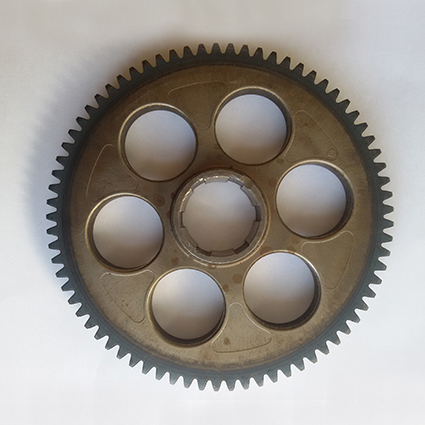
Manufacturing Flow (Powder Metallurgy, briefly)
- Material selection and blending (Fe/Cu/Ni/Mo as required) → compaction at high tonnage → sintering (typically 1120–1150°C in endo or N₂/H₂) → sizing/coin → machining where critical → heat treat (carburize or HF quench) → finishing (polish, coat) → 100% inspection on key dimensions. To be honest, the trick is tight control on density gradients and distortion after heat treatment.
Testing & Standards
Gear accuracy to ISO 1328-1 (often Grade 7–9 for PM Helical Gears), load rating per ISO 6336, hardness per ISO 6508, surface roughness ISO 4287. Automotive programs reference IATF 16949 APQP/PPAP; some buyers also cite AGMA 2015 for involute form checks. In-house noise tests show ≈3–5 dB(A) lower vs. spur gears at the same torque, which matches what we hear in the field, though real-world use may vary.
Service Life and Feedback
Typical life testing: >1,000 h at nominal load, with contact pattern inspections every 200 h. Many customers say chain buzz drops perceptibly when swapping to PM Helical Gears in the drive set. One appliance client reported 20% fewer warranty claims after a switch from cut spur to sintered helical idlers—small but meaningful.
Vendor Comparison (real-world buyer notes)
| Vendor | Certs | Lead Time | MOQ | Notes |
| JSSintering (Hebei) | ISO 9001, TS/IATF 16949 | ≈25–35 days | Low–mid | Strong PM control, competitive tooling |
| Cut Gear Shop (Domestic) | ISO 9001 | ≈15–25 days | Very low | Great prototypes; costlier at scale |
| Import OEM (Multiple) | Varies | ≈30–60 days | Mid–high | Wide capability; watch QC alignment |
Customization and Practical Specs
Module 0.5–4 (typical PM range), helix angle 15–30°, face width up to ≈35 mm, density tuned for strength vs. cost. Coatings like Dacromet and blackening help corrosion resistance in humid markets. Heat treat: carburizing to 58–62 HRC case with 0.6–1.0 mm effective case depth is common for drivetrain Helical Gears.
Case Study: Noise Down, Cost Flat
A Southeast Asian motorcycle OEM swapped its final-drive idler to a PM helical design. Result: −3.2 dB(A) at 4,000 rpm, +18% life to pitting onset (ISO 6336 method C), and no increase in unit cost after tooling amortization. Field dealers said riders “feel it” more than they hear it—smoother pull, less chain chatter.
Compliance, Plant, and Logistics
Origin: TIANSHAN INTERNATIONAL MANUFACTURING INDUSTRY PARK NO.57, YUANSHI, SHIJIAZHUANG CITY, HEBEI PROVINCE, CHINA. Programs run under ISO 9001 and TS/IATF 16949 frameworks with PPAP when needed. Packaging uses VCI + tray stacks; salt-spray data for coated parts routinely hits 72–120 h depending on finish.
Citations:
- ISO 1328-1:2019 – Cylindrical gears — ISO system of accuracy.
- ISO 6336-1:2019 – Calculation of load capacity of spur and helical gears.
- AGMA 2015-1-A01 – Accuracy classification system — Tangential measurements.
- IATF 16949:2016 – Automotive Quality Management System Requirements.









