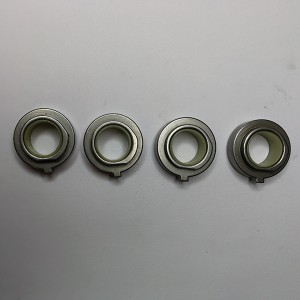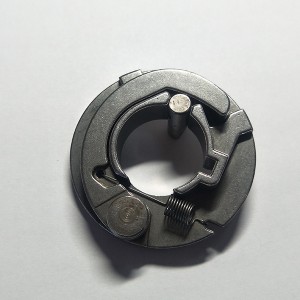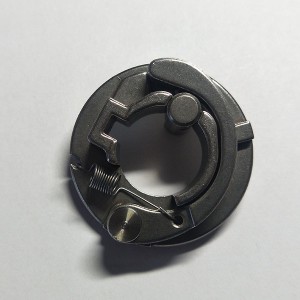





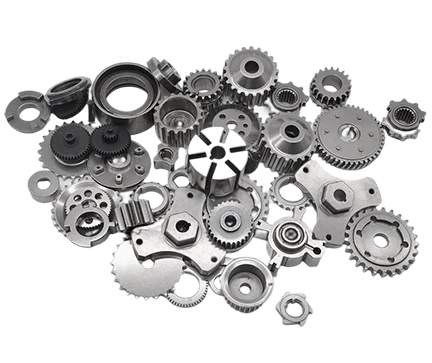

| Material | Iron Powder, Iron alloy powder |
| Certificate | ISO9001,TS16949 |
| Tolerance | +/- 0.002mm, |
| Density Range | 6-7.2/cm3(Fe) |
| Surface Treatment | Blacken,Dacromet Plated ,Polishing,Sand Blasting,Electroplating |
| Heat Treatment | Ordinary Quenching,Carburizing, Ritriding, High Frequency Quenching |
| Application | Sport Equipment,Home Appliances,Transmission Parts,Vehicle,etc |
| Performance | High Precision,High Wear Resistance,Low Noise,Smooth And Steady,Cheap |
| Processing Technic | Powder Metallurgy |
| Process | Mixing-Mechanical Forming-Hydraulic Molding-Detection Strength And Hardness-Packing And Shipping |
Production capacity: 100000pcs/month
Moulding production: 20days
Delivery date: 10-45days
Package: customized/PE bag+carton+wooden pallet
Production application: Powder metallurgy OEM gear, transmission gear, sintered gear widely used in the the gear box/reducer/mixer/blender/pump/machinery/power tools/oil pump/gear pump.
Sintered structural components for gearboxes are precision-engineered parts manufactured using advanced powder metallurgy technology. These components are designed to provide high strength, dimensional accuracy, and long-term durability in automotive and industrial gearbox systems, where reliability and performance are critical. By utilizing metal powders and sintering processes, these components can achieve complex shapes and integrated features that are difficult or costly to produce with traditional machining.
The manufacturing process involves compacting carefully selected metal powders into a mold under high pressure, followed by high-temperature sintering to fuse the particles into a solid, dense structure. This technique allows for tight tolerances, uniform density, and consistent mechanical properties across large production volumes. Additional processes, such as heat treatment, surface finishing, or machining, can further enhance the hardness, wear resistance, and fatigue strength of the components.
Common materials for sintered structural gearbox components include iron-based alloys, alloy steels, and copper-enhanced powders, depending on the load requirements, operating conditions, and environmental factors. Heat treatment techniques such as carburizing or induction hardening improve surface hardness while maintaining a tough core, ensuring the components withstand high torque, repeated stress, and continuous operation.
These components offer several advantages over traditionally machined parts, including reduced material waste, lower production costs, and the ability to manufacture complex geometries in a single step. Their controlled porosity can also retain lubricants, reducing friction and extending the service life of the gearbox.
Sintered structural components are widely used in automotive transmissions, industrial gearboxes, agricultural machinery, and electric drives, where high reliability, precision, and efficiency are required. By providing excellent dimensional stability, load-bearing capacity, and wear resistance, these components ensure smooth operation, improved energy efficiency, and long-term gearbox performance.
In summary, sintered structural components for gearboxes combine precision engineering, durable materials, and cost-effective manufacturing to deliver reliable, high-performance solutions for modern mechanical and automotive systems.
Key Applications of Sintered Structural Components in Automotive and Industrial Gearboxes
Sintered structural components are widely used in automotive and industrial gearbox systems due to their precision, durability, and cost-effective manufacturing. In automotive transmissions, these components are commonly employed in gear carriers, shafts, spacers, and internal support structures, where accurate alignment and high strength are critical for smooth operation. Their ability to maintain dimensional stability under high torque ensures reliable power transmission and reduces wear on mating parts.
In industrial gearboxes, sintered components are used in heavy machinery, conveyor systems, and electric drives. The controlled porosity of sintered materials can retain lubricants, which helps reduce friction and wear, even under continuous operation or variable load conditions. Their high strength-to-weight ratio allows engineers to design compact, lightweight gearboxes without compromising performance or reliability.
Sintered structural components also offer design flexibility, enabling the integration of multiple features—such as splines, holes, or bosses—into a single part. This reduces the number of assembly steps, lowers manufacturing costs, and improves overall system efficiency. Applications include automotive electric power steering systems, agricultural machinery gearboxes, small industrial reducers, and robotics transmissions.
By combining precision, durability, and cost-efficiency, sintered structural components play a vital role in modern gearbox design, ensuring smooth, reliable operation in both high-performance automotive and heavy-duty industrial applications.
Performance Benefits of High-Precision Sintered Gearbox Components
High-precision sintered gearbox components provide several performance advantages that directly impact efficiency, reliability, and durability. One of the primary benefits is accurate dimensional control, which ensures consistent engagement between gears, shafts, and other transmission elements. This precision reduces vibration, noise, and wear, enhancing the overall performance of the gearbox.
Another key advantage is enhanced strength and fatigue resistance. Sintered components are often made from iron-based or alloy powders and can be heat-treated to achieve the desired hardness and toughness. This allows them to withstand repeated stress, high torque, and continuous operation without deformation or failure.
The controlled porosity of sintered parts also offers self-lubricating properties, which help reduce friction, lower operating temperatures, and extend service life. Additionally, these components are lightweight compared to traditional machined parts, allowing for more compact gearbox designs and improved energy efficiency.
Other benefits include cost-effective production for high-volume applications and the ability to manufacture complex geometries in a single forming step. This reduces assembly complexity and improves overall system reliability.
Overall, high-precision sintered gearbox components enhance transmission efficiency, reduce maintenance requirements, and ensure consistent, long-term performance in both automotive and industrial gearboxes.
How to Choose the Right Sintered Structural Component for Your Gearbox Design
Selecting the right sintered structural component for a gearbox requires careful consideration of material, design, and operating conditions. The first factor is load and torque requirements. Components must withstand the forces they will encounter without deformation or premature wear, which influences the choice of material and heat treatment.
Material selection is critical. Iron-based powders are commonly used for general strength and cost-efficiency, while alloy steels provide higher fatigue resistance and hardness. Copper or nickel additives can improve corrosion resistance, wear performance, and conductivity in specialized applications.
The component geometry and precision are also important. Complex features such as splines, bosses, or integrated shafts may require advanced sintering processes or secondary machining. Tight dimensional tolerances are essential to ensure proper gear engagement, smooth rotation, and minimal vibration.
Environmental factors, including temperature, lubrication, and exposure to chemicals, must also be considered. Surface treatments or impregnation techniques can enhance corrosion resistance, reduce friction, and extend service life.
Finally, production volume and cost-effectiveness should guide the choice. Sintered components are ideal for high-volume applications due to their ability to produce complex geometries efficiently with minimal waste.
By evaluating these factors—load, material, precision, environment, and production needs—engineers can select the optimal sintered structural component, ensuring reliable, durable, and high-performance gearbox operation.