






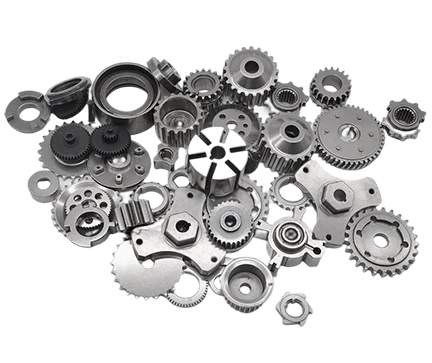
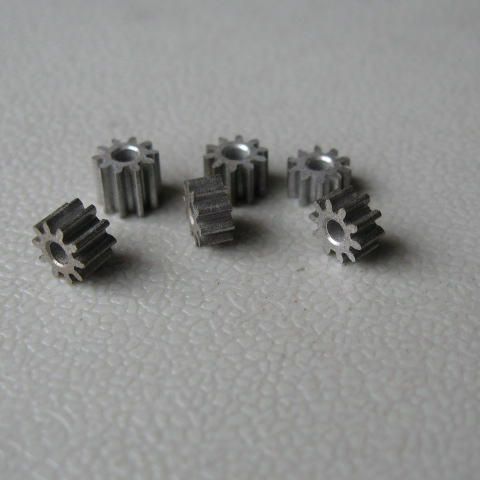
Product Description
Material Standard: MPIF 35, DIN 30910, JIS Z2550
Density: 6.2 - 7.1 g/cm3
Macro Hardness: 45-80 HRA
Tensile Strength: 1650 Mpa Ultimate
Yield Strength(0.2%): 1270 Mpa Ultimate
Size: Customized Size
| Material | Iron powder, alloy powder |
| Process |
metal powder→mixing→alloying→pressing,deformation→heat treatment→sintering→machining joining coating→quality assurance→package |
| Heat treatment | Ordinary quenching |
| Surface treatment | blacken, dacromet plated |
| Performance | High precision,high wear resistance,low noise, smooth and steady, high strength |
| Payment, minimum order and delivery | T/T, LC, Delivery time is Negotiation |
| Packaging | Carton box or customer requirement |
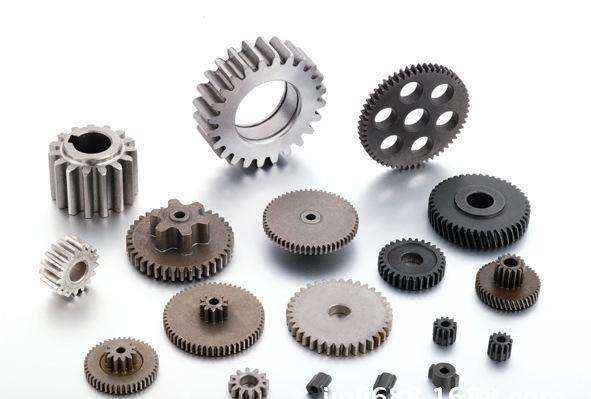
What Are The 4 Types Of Gears?
- Spur Gears
Spur gears are the most common and simplest type of gear. They have straight teeth and are mounted on parallel shafts. Known for their efficiency and ease of manufacturing, spur gears are ideal for low- to medium-speed applications where noise is not a major concern. Commonly found in machinery, clocks, and home appliances, they deliver consistent and precise power transmission. - Helical Gears
Helical gears feature angled teeth, allowing for smoother and quieter operation compared to spur gears. The angled design enables gradual engagement, which reduces shock and wear. Helical gears can transmit motion between parallel or non-parallel shafts and are widely used in automotive transmissions, industrial machinery, and robotics. - Bevel Gears
Bevel gears are used to transmit power between shafts that intersect at an angle, typically 90 degrees. They have conically shaped teeth and come in variations such as straight, spiral, and hypoid bevel gears. Bevel gears are ideal for applications requiring a change in drive direction, such as in differential drives and hand drills. - Worm Gears
Worm gears consist of a screw-like worm that meshes with a gear wheel. This type of gear offers high reduction ratios and excellent torque output in compact spaces. Worm gears also provide a self-locking function, preventing back-driving—making them perfect for lifts, conveyors, and tuning instruments.
Understanding the difference between normal (manual) and automatic gears is essential when selecting vehicles or designing transmission systems. Both gear types play the same fundamental role—transmitting engine power to the wheels—but they function very differently in terms of operation, control, and user experience.
Normal Gear (Manual Transmission)
Manual gear systems require the driver to engage and shift gears manually using a clutch pedal and gear lever. The driver has full control over gear selection, which can enhance fuel efficiency and driving performance, especially in experienced hands. Manual transmissions are typically lighter, more affordable to maintain, and are preferred in performance or off-road vehicles due to their responsive control and mechanical simplicity.
Automatic Gear (Automatic Transmission)
Automatic gears shift automatically based on speed, load, and throttle position, using a torque converter and a complex hydraulic or electronic system. This type of transmission is user-friendly and ideal for urban or high-traffic driving, as it eliminates the need for clutch operation and manual gear changes. While traditionally more expensive and heavier than manuals, modern automatics offer improved efficiency and smooth gear transitions, with many equipped with smart driving modes.
In summary, manual gears offer precision and driver engagement, while automatic gears provide convenience and ease of use. The choice depends on driving conditions, user preferences, and application needs.
Looking for the right transmission component or gear solution for your vehicle project? Get in touch with us for tailored products and expert guidance. Are you developing for city cars, trucks, or performance vehicles?











