






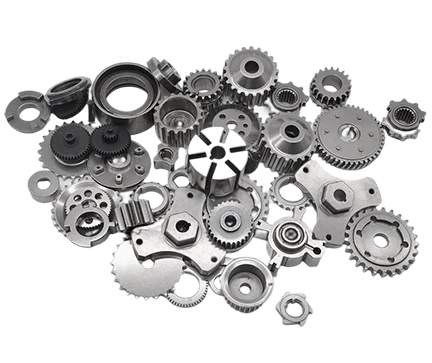
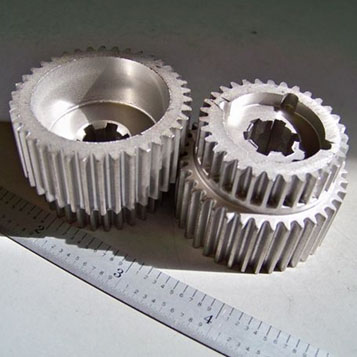
Place of Origin: Hebei, China
Model Number: OEM offered
Material: Iron based powder
Brand: Jingshi
Specifications
1. High density
2. Good abrasion resistance&hardness
3. High precision
4. Good strength
5. Excellent small module gears
|
Product Name |
Spur Gears |
|
Material |
Iron powder/Steel/Stainless Steel/Cooper/Nickel |
|
Technology |
Powder Metallurgy - Machining |
|
Certificate |
ISO9001/TS16949 |
|
Surface Treatment |
High Frequency quenching, Oil impregnation |
|
Unspecified Tolerance |
ISO 2768 - m / H14, h14, +- IT14/2 |
|
Apperance |
No Crumbling, Cracks, Exfoliation, Voids, Metal Pitting and Other Defects |
|
Process Flow |
Powder mixing - Forming - Sintering - Oil impregnation - Sizing -Ultrasonic Cleaning - Steam Oxidation - Oil impregnation - Final inspection - Packing |
|
Application |
Industry,Vehicle, Power Tools, Motor, Bicycle, Electrombile |
Material Selection and Manufacturing Process of Powder Metal Hammer Drill Gears
The powder metal hammer drill gear is a crucial component in modern power tools, particularly hammer drills, where it ensures smooth torque transmission and high durability under heavy-duty operation. The reliability and performance of these gears depend heavily on material selection and the powder metallurgy manufacturing process.
Material selection is the foundation of a high-performance powder metal gear. Typically, iron-based powders are used due to their strength, machinability, and cost efficiency. To meet the demanding requirements of hammer drills, these powders are often alloyed with elements such as copper, nickel, or molybdenum. Copper improves compressive strength and reduces friction, nickel enhances toughness, and molybdenum increases wear resistance and fatigue life. The combination of these elements ensures that the gear can withstand high torque, repeated shock loads, and extended operational cycles.
The manufacturing process begins with the preparation of a homogeneous powder blend. Uniform particle size and composition are critical to achieving consistent density and mechanical properties in the final product. Once the powder blend is ready, it is compacted in precision dies under high pressure, forming a green compact with near-net shape geometry. This stage allows complex features, such as internal hubs or flanges, to be integrated without additional machining, reducing production costs and improving accuracy.
Sintering is the next step in the process. The green compact is heated in a controlled-atmosphere furnace, where metal particles bond metallurgically without melting the base material. Proper control of temperature, atmosphere, and duration ensures uniform densification, optimal hardness, and excellent fatigue performance. In many cases, post-sintering treatments such as heat treatment, surface densification, or carburizing are applied to improve wear resistance and extend gear lifespan.
Additionally, oil impregnation can be incorporated into the porous structure of powder metal gears. This allows self-lubrication during operation, reducing friction, wear, and heat generation—particularly beneficial for hammer drills, which operate at high speeds and generate significant impact loads.
By combining careful material selection with precise powder metallurgy manufacturing techniques, powder metal hammer drill gears achieve an optimal balance of strength, durability, and cost-effectiveness. This ensures consistent performance in demanding environments while reducing maintenance requirements and production costs.
Common Applications of Powder Metal Hammer Drill Gears Across Power Tools
Powder metal hammer drill gears are widely used across various power tool applications due to their durability, precision, and ability to withstand heavy-duty operation. These gears are specifically designed to manage the high torque and repetitive impact loads generated by hammer drills and similar tools.
One of the primary applications is in rotary hammer drills, where the gear transmits power from the motor to the percussion mechanism. In this context, the gear must endure repeated impact loads while maintaining precise engagement with other components. Powder metal gears provide the required strength and dimensional accuracy, ensuring consistent hammering performance even under continuous operation.
Another common application is in cordless hammer drills and impact drivers. These tools demand lightweight and compact components that do not compromise performance. Powder metallurgy allows manufacturers to produce gears with near-net-shape geometry, reducing weight and the number of assembly parts while maintaining high strength. Self-lubricating features further enhance performance, reducing the need for frequent maintenance.
Powder metal hammer drill gears are also used in industrial-grade power tools, including demolition hammers, rotary chisels, and specialized drilling equipment. In these scenarios, gears must resist extreme loads, abrasive environments, and high operational cycles. The precise manufacturing and material selection inherent to powder metallurgy ensure that gears can operate reliably under such demanding conditions.
Additionally, these gears find applications in accessory attachments for power tools, such as hammer drill adapters, rotary mechanisms, or gear-driven attachments. The ability to integrate multiple functional features during powder metallurgy production—such as hubs or mounting flanges—simplifies assembly and improves mechanical reliability.
Overall, the versatility of powder metal hammer drill gears makes them essential in modern power tool design. Their consistent performance, durability, and cost-effectiveness contribute to longer tool life, better efficiency, and improved user experience across a wide range of applications.
Performance and Durability of Powder Metal Hammer Drill Gears Under High Load Conditions
The performance and durability of powder metal hammer drill gears are critical factors in ensuring reliable operation under high load and impact conditions. Hammer drills generate significant torque and repetitive impact forces, placing extreme demands on gear components. Powder metallurgy offers a solution that combines strength, precision, and long-term reliability.
Performance begins with material properties. Iron-based alloy powders, often combined with copper, nickel, or molybdenum, provide a strong, wear-resistant foundation. Copper enhances strength and reduces friction, nickel improves toughness, and molybdenum increases fatigue resistance. These material properties allow the gear to handle the repeated high-impact cycles typical of hammer drill operation.
The precision of powder metallurgy manufacturing also contributes to performance. Near-net-shape production ensures consistent tooth geometry and tight tolerances, minimizing backlash and vibration. Proper engagement between gear teeth ensures smooth torque transmission, reduces mechanical noise, and improves the overall efficiency of the hammer drill.
Durability under high load conditions is further enhanced through post-sintering treatments. Carburizing, induction hardening, or surface densification improves tooth surface hardness, reducing wear while preserving a tougher core to absorb shocks. In addition, oil impregnation of the porous gear structure provides self-lubrication, reducing friction and extending service life even under extreme operational loads.
Powder metal hammer drill gears are designed to withstand both static and dynamic loads. Static loads include high torque during drilling through dense materials, while dynamic loads involve repeated hammering impacts. The combination of optimized materials, precise geometry, and lubrication ensures that gears can operate reliably over extended cycles without deformation or tooth failure.
Moreover, these gears are resistant to environmental factors such as dust, moisture, and vibration, which are common in construction and industrial settings. Protective coatings or controlled alloying further improve corrosion resistance, ensuring long-term durability.
In conclusion, powder metal hammer drill gears deliver superior performance and durability under high load conditions. Their advanced material composition, precision manufacturing, and self-lubricating design make them an essential component in high-performance power tools, ensuring reliability, efficiency, and extended service life.











