




THE BUYER'S GUIDE / SELECTION
Choosing Sintered Components for Gearbox Applications: Application Fit and Specification Checks
Selecting the right sintered components for a gearbox requires matching material grades, dimensional tolerances, density ranges, surface treatments, and heat treatment options to the specific demands of the transmission system. This guide draws on confirmed product specifications from SHIJIAZHUANG JINGSHI NEW MATERIAL SCIENCE AND TECHNOLOGY CO.,LTD to walk procurement teams and engineers through the key criteria that determine whether sintered metal components will perform reliably in automotive, industrial, and power-tool gearboxes.

Material and base powder compatibility (iron powder, iron alloy powder, stainless steel, copper, alloy steel with C/Sn/Zn variants) — confirmed material options must match the load, corrosion, and temperature requirements of the gearbox application.
Dimensional tolerance class (±0.002 mm for precision gearbox components; ±0.01 mm for general sintered components) — the correct tolerance class must be specified on inquiry drawings to ensure fit at gear mesh, shaft, and bearing interfaces.
Density range (6.0–7.2 g/cm³ for iron-based gearbox parts; 6.0–7.9 g/cm³ for general sintered components; up to 6.9 g/cm² for sintered structural parts) — higher density supports greater load-bearing capacity and fatigue resistance for high-torque or shock-loaded gearboxes.
Heat treatment compatibility (ordinary quenching, carburizing, nitriding/ritriding, high-frequency induction quenching) — the selected heat treatment must be confirmed as compatible with the chosen base powder and must achieve the required surface hardness and core toughness for the duty cycle.
Surface treatment suitability for service environment (blackening, Dacromet plating, polishing, sand blasting, electroplating, oil impregnation, tumbling, machining) — oil-bath gearboxes favour oil impregnation for self-lubrication; exposed assemblies may require electroplating or Dacromet for corrosion protection.
Compliance with applicable dimensional standard (DIN, JIS, ASTM, GB) — the standard must align with the end-market acceptance criteria and be stated explicitly at the design-for-manufacture stage.
Production volume and lead time fit (confirmed capacity: 100,000 pcs/month; moulding production: 20 days; delivery: 10–45 days) — program schedules must accommodate these lead times, and volume forecasts should be communicated early for high-volume programs.
Why Sintered Components Are Used in Gearboxes
Sintered components are manufactured by compacting metal powders—most commonly iron-based alloys, alloy steels, and copper-enhanced powders—under high pressure and then sintering them at elevated temperatures to form a dense, solid structure. This powder metallurgy process allows complex internal geometries to be produced in a single step, delivers tight dimensional tolerances, and supports large production volumes with consistent mechanical properties. For gearbox applications in particular, these traits translate into compact part counts, repeatable assembly fit, and the ability to retain lubricants through controlled porosity, all of which reduce running noise and extend service life.
Before specifying sintered metal components for a gearbox, buyers must verify that the candidate parts satisfy the load, dimensional, material, and surface requirements of the application. The sections below identify the criteria that matter most and explain how confirmed product specifications map to those requirements.
Key Selection Criteria
1. Material and Base Powder Compatibility
The base powder determines the mechanical foundation of any sintered component. Confirmed materials available include iron powder, iron alloy powder, stainless steel, copper, steel, and alloy steel (including variants with C, Sn, and Zn additions). For gearbox duty cycles involving high torque or continuous load, iron alloy and alloy steel powders are the typical starting point because they support the hardness and strength levels needed after sintering and heat treatment. Stainless steel powders may be appropriate where corrosion resistance is a secondary requirement alongside mechanical performance.
Buyers should confirm which base powder is specified for their part at the time of inquiry. Keywords alone do not establish a material grade; the confirmed product specification sheets govern.
2. Density Range and Structural Integrity
Sintered part density directly affects strength, hardness, and the ability to withstand repeated stress cycles.
- Iron-based sintered structural gearbox components: 6.0–7.2 g/cm³
- General sintered components (multi-material range): 6.0–7.9 g/cm³
- Sintered structural parts: up to 6.0–6.9 g/cm²
Higher density generally correlates with improved load-bearing capacity and fatigue resistance. For high-torque gearboxes or applications subject to shock loading, buyers should target the upper end of the available density range and confirm with the supplier which compaction and sintering parameters achieve that density for the selected material.
3. Dimensional Tolerance
Gearbox fit and running clearance are critical. Confirmed tolerance capabilities from product specifications are:
- ±0.002 mm (iron-based gearbox components)
- ±0.01 mm (general sintered components)
The tighter ±0.002 mm tolerance is relevant for precision gear mesh, shaft interfaces, and bearing seats where deviation directly affects noise and wear rates. Buyers should state the required tolerance class on inquiry drawings so the appropriate process parameters and post-sintering operations (sizing, grinding) can be applied.
4. Applicable Heat Treatment Options
Heat treatment transforms sintered blanks into gearbox-ready components with the required surface hardness and core toughness. Confirmed heat treatment options include:
- Ordinary quenching
- Carburizing
- Nitriding (Ritriding)
- High frequency (induction) quenching
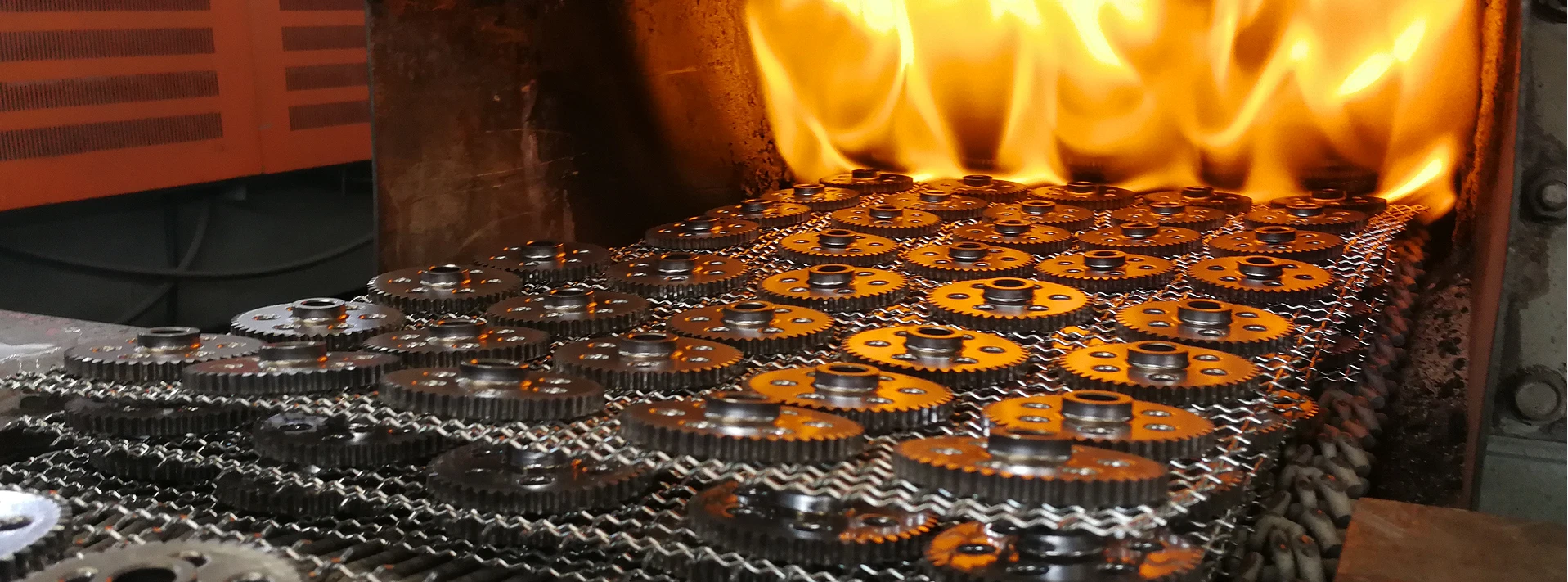
For gearbox gears and transmission parts subject to contact fatigue and abrasive wear, carburizing or high-frequency quenching are typically specified to develop a hard case over a ductile core. Nitriding can be selected where dimensional change after heat treatment must be minimized. Not every heat treatment option is equally appropriate for every material; buyers should confirm compatibility between the selected base powder and the intended heat treatment route before finalizing the part specification.
5. Surface Treatment and Finishing
Surface finishing affects corrosion resistance, friction coefficient, appearance, and dimensional fine-tuning. Confirmed surface treatment options include:
- Blackening (steam oxidation / surface bluing)
- Dacromet plating
- Polishing
- Sand blasting (shot peening)
- Electroplating
- Oil impregnation / oil immersion
- Tumbling
- Machining
For enclosed gearboxes operating in oil baths, oil impregnation of the sintered component itself provides self-lubricating behavior that reduces friction and wear during cold starts or periods of marginal lubrication. Blackening or steam oxidation is commonly used for iron-based parts to add mild corrosion resistance and a uniform appearance. Buyers should specify the intended service environment—wet, dry, or oil-bath—when requesting a surface treatment recommendation.
6. Applicable Industry Standards
Confirmed standards referenced in product specifications include DIN, JIS, ASTM, and GB. Buyers sourcing for export markets in the United States, Europe, the Middle East, and Southeast Asia should confirm which standard applies to their part and communicate it explicitly at the design-for-manufacture stage. Holding a part to the wrong standard can affect dimensional interchangeability and inspection acceptance criteria.
7. Production Volume and Lead Times
The production capacity is 100,000 pcs/month for sintered structural gearbox components. Moulding production lead time is 20 days, with overall delivery dates of 10–45 days depending on order complexity and finishing requirements. Buyers planning gearbox programs should factor these lead times into their program schedules and communicate volume forecasts early to secure capacity for large runs.
Applicable Products from SHIJIAZHUANG JINGSHI NEW MATERIAL SCIENCE AND TECHNOLOGY CO.,LTD
The following confirmed products are relevant to gearbox selection decisions:
| Product | Key Specification Highlights | Typical Gearbox Use |
|---|---|---|
| Sintered structural components for gearbox | Material: iron/iron alloy; Density: 6.0–7.2 g/cm³; Tolerance: ±0.002 mm; Heat treatment: quenching, carburizing, nitriding, HF quenching; Surface: blackening, Dacromet, polishing, sand blast, electroplating | Transmission gears, reduction gears, gear pump components, power tool gearbox parts |
| Sintered components (general range) | Material: iron, iron alloy, stainless steel, copper, alloy steel; Density: 6.0–7.9 g/cm³; Hardness: HRA 30–80; Tolerance: ±0.01 mm; Surface: HF quenching, oil impregnation, tumbling, plating, steam treating | Automotive, household appliances, commercial machines, electronic equipment |
| Sintered structural parts | Material: iron, iron alloy, stainless steel, copper, alloy steel (C, Sn, Zn); Density: 6.0–6.9 g/cm²; Surface: machining, oil immersion, steam oxidation, electroplate, surface bluing; Standards: DIN, JIS, ASTM, GB | Automotive, home appliances, power tools, medical devices, mechanical manufacturing |
How to Match a Gearbox Requirement to a Sintered Component
Use the following checklist to evaluate application fit before placing an order:
- Define the load profile. Identify peak torque, continuous operating load, shock events, and duty cycle. Higher loads require higher density and carburizing or induction hardening.
- State dimensional tolerances on drawings. If running clearances require ±0.002 mm, specify gearbox-specific components; general sintered components are rated to ±0.01 mm.
- Confirm the material grade. Match the base powder to corrosion, temperature, and strength requirements. Iron alloy powders cover most gearbox applications; stainless or copper-enhanced grades serve specialist environments.
- Select a compatible heat treatment. Cross-reference the base material with the available options (quenching, carburizing, nitriding, HF quenching) to confirm the process is supported before committing to a design.
- Specify the surface treatment for the service environment. Oil-bath gearboxes benefit from oil impregnation; external or exposed housings may require electroplating or Dacromet for corrosion protection.
- Check applicable standards. State DIN, JIS, ASTM, or GB as required by your end-market acceptance criteria.
- Confirm production volume fit. For high-volume programs, verify that the 100,000 pcs/month production capacity and the 10–45 day delivery window align with your program timeline.
When Sintered Components May Not Be the Right Fit
Sintered components offer clear advantages in volume production and geometric complexity, but there are situations where they may not be appropriate:
- Very high section thickness with extreme density requirements: Powder metallurgy compaction has practical limits for thick cross-sections, so extremely large or heavy structural gearbox members may be better served by casting or forging.
- Ultra-high surface hardness across the full cross-section: Full-section through-hardening to very high hardness levels can be limited by the achievable density of sintered parts compared with wrought steel.
- One-off or very low prototype volumes: The tooling investment for powder metallurgy dies makes sintered components most cost-effective at medium-to-high production volumes. Buyers needing only a handful of prototype parts may find machining from bar stock more economical.
These limitations should be discussed with the supplier during the design-for-manufacture consultation stage.
Summary
Choosing sintered components for a gearbox comes down to a disciplined check across seven dimensions: base material, density, tolerance, heat treatment, surface treatment, applicable standard, and volume fit. SHIJIAZHUANG JINGSHI NEW MATERIAL SCIENCE AND TECHNOLOGY CO.,LTD offers confirmed sintered metal components that cover iron-based and multi-material grades, tolerances from ±0.002 mm to ±0.01 mm, and a full menu of heat treatment and surface finishing options, all validated to ISO9001 and TS16949 standards. Procurement teams and design engineers should use the criteria above as a structured checklist when submitting an inquiry to ensure the selected part matches the specific demands of their gearbox system.
THE PEOPLE

About the author
THE COMPANY
SHIJIAZHUANG JINGSHI NEW MATERIAL SCIENCE AND TECHNOLOGY CO.,LTD
Shijiazhuang JingShi New Material Science and Technology Co.,ltd was founded since 2014, located in Shijiazhuang, Hebei province,China.The company covers an area of over 10,000 square meters and has a total investment of over 30 million yuan. Passed the TS16949 Certificate. It is a comprehensive high-tech enterprise integrating research, development, production and sales of powder metallurgy OEM parts.…
About Us ↗Visit company website ↗YOUR NEXT STEP
Bring your brief. Start a useful conversation.
Use case, specification, quantity and delivery window: make the next conversation specific.