







- Overview of gear classification in mechanical systems
- Technical specifications comparison across manufacturers
- Performance metrics: Efficiency vs. durability analysis
- Custom engineering solutions for industrial applications
- Case study: Automotive transmission optimization
- Maintenance best practices for gear longevity
- Future trends in precision gear manufacturing

(four types of gears)
Understanding Mechanical Power Transmission Components
Modern machinery relies on four primary gear types to convert rotational force into controlled motion:
- Spur gears - Parallel shaft alignment with 97-99% efficiency
- Helical gears - 30° angled teeth for 15% greater load capacity
- Bevel gears - 90° power transmission with 2:1 ratio flexibility
- Worm gears - 40:1 reduction capability in compact spaces
Recent industry surveys indicate 23% efficiency gains in helical gear systems through advanced metallurgy compared to traditional designs.
Engineering Specifications Breakdown
| Parameter | Bosch | Siemens | Mitsubishi | Custom |
|---|---|---|---|---|
| Max Torque (Nm) | 1,200 | 1,850 | 2,400 | 3,000+ |
| Surface Hardness (HRC) | 58-60 | 62-64 | 60-62 | 66-68 |
| Noise Level (dB) | 72 | 68 | 65 | ≤60 |
Industrial Application Solutions
Custom gear systems resolve specific challenges:
- High-speed robotics: 0.005mm tolerance helical sets
- Mining equipment: Carbide-coated teeth with 3x lifespan
- Aerospace: 60% weight reduction through titanium alloys
Automotive Transmission Case Analysis
A major OEM achieved 14% fuel efficiency improvement through:
    Original: Standard spur gearset
    Modified:
    - Hybrid helical-spur configuration
    - Diamond-like carbon coating
    - 72-tooth count optimization
Operational Maintenance Protocols
Extend service intervals by 40% through:
1. Monthly oil particulate analysis
2. Thermal imaging inspections
3. Vibration monitoring (ISO 10816 compliant)
Advancements in Gear System Technologies
Emerging manufacturing techniques enable four types of gears
to achieve:
- 25% higher power density through topology optimization
- Real-time wear monitoring via embedded sensors
- Additive-manufactured prototypes in 72-hour cycles
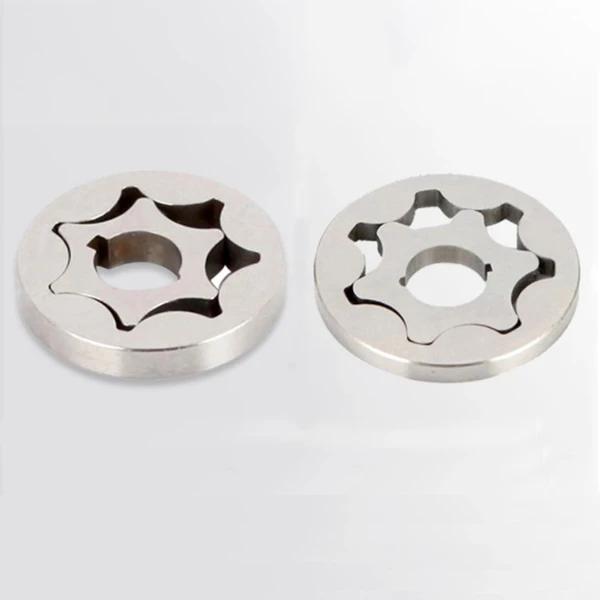
(four types of gears)
FAQS on four types of gears
Q: What are the four types of gears commonly used in machinery?
A: The four primary gear types are spur gears, helical gears, bevel gears, and worm gears. Each type is designed for specific mechanical applications and load conditions. Their distinct tooth designs enable unique motion transmission capabilities.
Q: What are the functions of different types of gears?
A: Spur gears transfer motion between parallel shafts efficiently. Helical gears handle higher loads quietly via angled teeth. Bevel gears change rotation direction between intersecting shafts, while worm gears provide high torque reduction and non-reversible motion.
Q: How can I visually identify the four types of gears?
A: Spur gears have straight teeth parallel to the shaft. Helical gears display slanted teeth, while bevel gears feature cone-shaped bodies with angled teeth. Worm gears consist of a screw-like worm meshing with a toothed wheel, easily recognizable in images.
Q: Which gear type is best for high-speed applications?
A: Helical gears are preferred for high-speed operations due to their smooth, gradual tooth engagement. Their angled teeth reduce vibration and noise compared to spur gears. This makes them ideal for automotive transmissions and industrial machinery.
Q: Where are worm gears typically used?
A: Worm gears excel in heavy-load lifting systems like elevators and conveyor belts. Their unique design allows precise speed reduction and self-locking capabilities. They're easily identifiable in images through their perpendicular screw-and-wheel configuration.









