




A suitable motor gear must match the transmission layout, material, tooth grade, weight, and surface treatment of the assembly. Our OEM powder metallurgy sintered double gear is made for power tools, starters, motors, and gearboxes, with custom non-standard production, iron powder or alloy options, and treatments including high-frequency quenching and oil impregnation.

Transmission fit: confirm the double-gear layout, tooth geometry, mating gear, shaft interface, center distance, housing clearance, and overall dimensions.
Material and production fit: select iron powder or alloy, define gear grade 6 to 10, specify surface treatment, and confirm the 5 to 50 g weight range, density, hardness, and inspection dimensions.
Start with the transmission layout
Choose a double gear when the assembly needs two gear sections in one compact component. Our OEM powder metallurgy sintered double gear is made for power tools, gearboxes, motors, and starters. The integrated form suits equipment where the gear must transfer motion through a confined transmission space.
A double gear can combine two gear profiles with different tooth counts or modules. In a motor-driven system, the first section receives rotation from the motor side and the second section transfers it to the next stage. This arrangement can support speed reduction and torque transfer while keeping the transmission layout compact.
Picture a power tool gearbox during assembly. The gear must sit at the correct center distance, mesh with the mating gear, and fit within the housing without interference. Send the gear drawing, mating gear information, and available housing space before requesting production so we can assess the complete fit.
Check the gear and material requirements
The product is available in gear grades 6 to 10, with iron powder and alloy options. The broader spur gear material range includes iron powder, steel, stainless steel, copper, and nickel. Select the material around the load, mating components, and working environment specified for your application.
Iron powder or alloy is a practical starting point for many power tool and motor gear designs. Steel, stainless steel, copper, or nickel may be considered when the design calls for a different material choice. The material decision should remain connected to the tooth geometry, operating load, and surface treatment.
The product is a non-standard part, so your drawing controls the integration work. Include tooth count, module or pitch information, bore and shaft details, double-gear spacing, overall dimensions, and critical tolerances in the design package. A sample can also support development when a CAD, 3D, or PDF drawing is not ready.
Match surface treatment to the working part
High-frequency quenching and oil impregnation are available for the motor gear. Quenching is relevant when the tooth surface needs a specified treatment, while oil impregnation suits powder metallurgy parts where lubrication within the porous structure is part of the design approach.
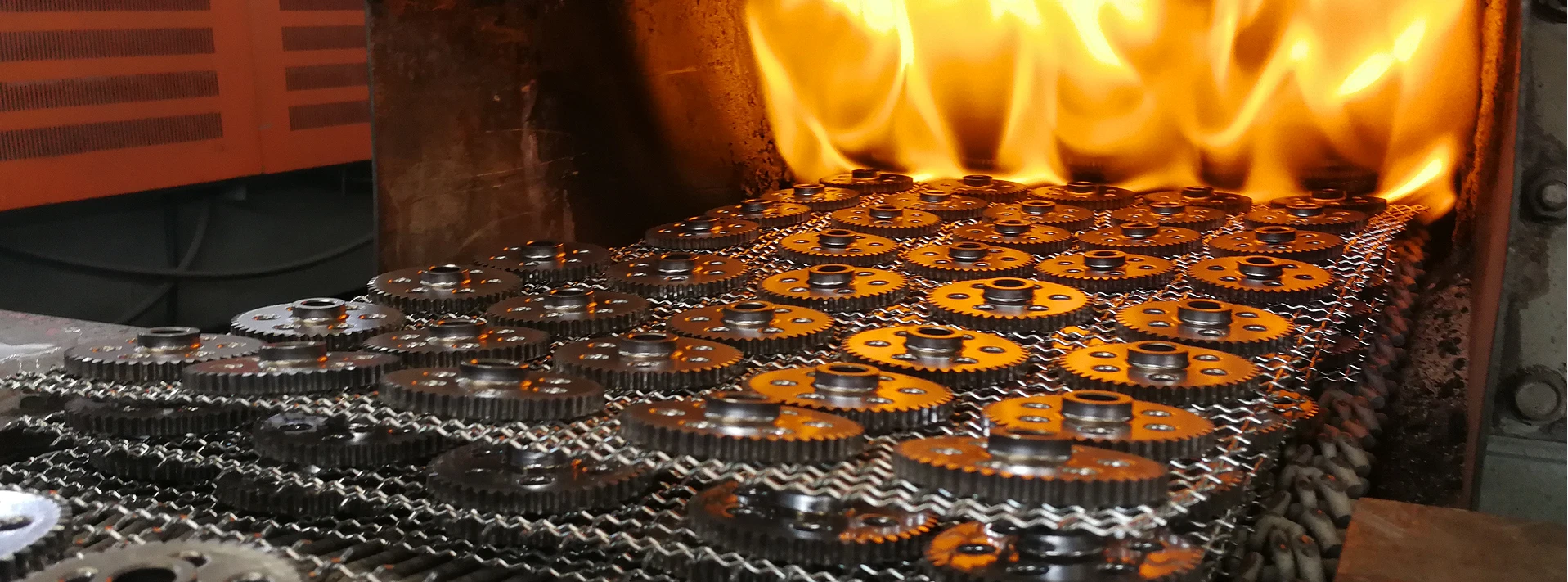
Our process route includes powder mixing, forming, sintering, oil impregnation, sizing, ultrasonic cleaning, steam oxidation, final inspection, and packing. This sequence gives you several points to define in the production request, especially when the gear must combine a formed profile with a secondary sizing or treatment operation.
For a compact power tool, check the tooth contact area, shaft interface, lubrication arrangement, and surrounding clearance together. For a starter or motor assembly, confirm the gear's position and mating profile before choosing the final treatment.
Use weight and appearance as order checks
The double gear has a weight range of 5 to 50 g. This suits small power tool, starter, and motor components where the gear's mass forms part of the rotating assembly calculation. Put the target weight on the drawing when it is an integration requirement.
The finished part should have no crumbling, cracks, exfoliation, voids, metal pitting, or other listed surface defects. These checks are useful at incoming inspection and during first-article approval. They do not replace dimensional inspection of the bore, tooth profile, spacing, and overall envelope.
Our powder metallurgy gear production can include sizing, ultrasonic cleaning, steam oxidation, and final inspection. Identify function-critical dimensions on the drawing so the inspection plan follows the way the gear works in your equipment.
Which motor gear fits your project?
The OEM powder metallurgy sintered double gear fits a power tool, starter, motor, or gearbox project that needs a custom non-standard part, compact double-gear geometry, a 5 to 50 g target range, and a choice of iron powder or alloy material. Its gear grade range is 6 to 10, and available treatments include high-frequency quenching and oil impregnation.
Choose this product when your project team can define the mating gear, shaft interface, mounting space, operating load, and treatment requirement. We can use a CAD, 3D, or PDF drawing, or a physical sample, as the starting point for a custom gear discussion. Send the assembly drawing with the required quantity and inspection dimensions.
Questions to settle before ordering
What density range is available for this motor gear?
The listed density range is 6.2 to 7.1 g/cm3. Use that value when your assembly calculation depends on the relationship between gear volume and mass. Give us the target density with the gear geometry, material choice, and target weight so the request connects the physical design to the powder metallurgy route.
What hardness range can the double gear provide?
The listed macro hardness range is 20 to 43 HRC. This is a specific input for a design team setting a hardness requirement for the part. Put the required range next to the tooth geometry and treatment request, because the double gear also has a choice of high-frequency quenching or oil impregnation.
Which mechanical strength values should be placed on the request?
The listed tensile strength is 1650 MPa, and the listed ultimate yield strength at 0.2% is 1270 MPa. Use these figures as design inputs alongside the operating load and tooth geometry. Send the load case and critical dimensions with the drawing so we can review the requested material and treatment together.
Can the design team submit a physical sample instead of a CAD file?
Yes. We can start from a physical sample, or from a CAD, 3D, or PDF drawing. A sample is useful when the existing motor gear must be reproduced or adapted. Include the mating gear and housing information as well, because the sample alone does not describe the complete transmission fit.
Send the assembly details with the gear request
Our OEM powder metallurgy sintered double gear suits custom motor and power tool assemblies that need integrated gear sections and a defined material or treatment. Send the mating gear drawing, shaft and housing dimensions, target weight, density or hardness requirement, surface treatment, quantity, and inspection points so we can review the motor gear for your application.

About the author
The company
SHIJIAZHUANG JINGSHI NEW MATERIAL SCIENCE AND TECHNOLOGY CO.,LTD
Shijiazhuang JingShi New Material Science and Technology Co.,ltd was founded since 2014, located in Shijiazhuang, Hebei province,China.The company covers an area of over 10,000 square meters and has a total investment of over 30 million yuan. Passed the TS16949 Certificate. It is a comprehensive high-tech enterprise integrating research, development, production and sales of powder metallurgy OEM parts.…
About Us ↗Visit company website ↗