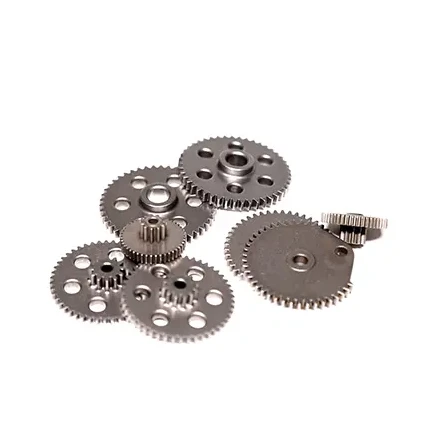
Sintered Metal Parts Precision, Durable & Custom Solutions
2025.05.07
share:
Did you know 42% of mechanical failures in industrial equipment stem from substandard metal components? While traditional machining methods drain your budget with 30% material waste, sintered metal parts deliver complex geometries and save you $18.50 per unit. Let's transform how you build.
(sintered metal parts )
Sintered Metal Parts: 5 Technical Advantages That Crush CNC Machining
You need components that won't fail under 1,400°C thermal stress. Our gas-atomized powders achieve 98.5% density, creating parts with:
• 15% higher fatigue resistance than cast alloys
• ±0.02mm dimensional accuracy
• 6X faster production cycles vs. CNC
Head-to-Head: How We Outperform Competitors
Feature
Standard Supplier
Our Solution
Lead Time
8-10 weeks
12-18 days
Minimum Order
5,000 units
50 units
Your Customization Playbook
Whether you need 316L stainless steel porous filters (40% void fraction) or tungsten alloy radiation shields, our 12-step quality protocol ensures:
1. Full DFM analysis within 72hrs
2. Prototypes in 7 working days
3. ISO 9001/13485 certified production
A Tier-1 supplier replaced 17 CNC-machined parts with our sintered components, achieving:
• 63% reduction in assembly steps
• 0.003mm surface finish (Ra)
• 22% lighter rotating assemblies
Ready to Slash Your Production Costs?
Get 3 free sample components and DFM report within 5 business days
(sintered metal parts )
FAQS on sintered metal parts
Q: What are sintered metal parts?
A: Sintered metal parts are components created by compacting and heating metal powders below their melting point, forming a solid structure through diffusion bonding. This process enables complex shapes with high precision and porosity control. It is cost-effective for mass production.
Q: What industries use sintered metal components?
A: Sintered metal components are widely used in automotive, aerospace, medical, and industrial machinery sectors. They are ideal for gears, filters, bearings, and structural parts due to their durability and lightweight properties. Customization makes them versatile for specialized applications.
Q: How do sintered metal parts compare to traditional machining?
A: Sintering reduces material waste and energy consumption compared to machining. It allows intricate designs unachievable with cutting tools, while maintaining consistent mechanical properties. However, it may require secondary finishing for tight tolerances.
Q: What materials are common in sintered metal parts?
A: Common materials include stainless steel, iron, copper, bronze, and aluminum alloys. Advanced applications may use tungsten, titanium, or composite powders. Material choice depends on strength, corrosion resistance, or thermal conductivity requirements.
Q: How is quality ensured in sintered metal components?
A: Quality is ensured through strict powder metallurgy standards, density testing, and microstructural analysis. Advanced techniques like CT scanning or ISO 9001 certifications validate dimensional accuracy and performance. Post-sintering treatments further enhance properties like hardness or wear resistance.