







Introduction to Advanced Gear Technologies
In the realm of mechanical power transmission, the efficacy and longevity of machinery fundamentally depend on the quality and design of its gears. Precision-engineered gear teeth types are critical components across a myriad of industrial applications, from heavy-duty mining equipment to delicate robotic systems. This article delves into the intricate world of modern gear manufacturing, focusing on material science, advanced processes, and the resulting performance advantages that drive industrial progress. We will explore the latest industry trends, technical specifications, and the profound impact of specialized manufacturing techniques like powder metallurgy on critical components such as powder metal hammer drill gears.
Industry Trends and Market Demands for Precision Gears
The global industrial landscape is increasingly demanding higher performance, greater energy efficiency, and extended service life from mechanical components. This trend is particularly pronounced for gear teeth types, which are the heart of most rotating machinery. Key drivers include the push for Industry 4.0 automation, which requires more precise and reliable motion control, and the emphasis on sustainable manufacturing, necessitating materials and processes that reduce waste and energy consumption. There is a continuous demand for gears that can withstand extreme conditions—high torque, varying temperatures, and corrosive environments—while maintaining optimal performance and minimizing noise and vibration.
Innovations in material science, such as advanced alloy steels and ceramic composites, alongside breakthroughs in manufacturing technologies like powder metallurgy and additive manufacturing, are shaping the future of gear production. These advancements enable the creation of complex gear teeth types with superior mechanical properties, often at a lower cost and with less material waste than traditional methods. The market for industrial gears is projected to grow significantly, driven by infrastructure development, growth in automotive, aerospace, and renewable energy sectors, all of which rely heavily on robust and efficient gear systems.
Understanding Diverse Gear Teeth Types and Their Applications
The selection of appropriate gear teeth types is paramount to the operational efficiency and reliability of any mechanical system. Each type offers distinct advantages based on its tooth geometry, meshing characteristics, and intended application. Understanding these different gear types with images in mind, aids engineers in optimal design choices.
- Spur Gears: The simplest and most common gear teeth types, spur gears have straight teeth mounted on parallel shafts. They are efficient and cost-effective for applications requiring moderate speeds and loads, such as washing machines, clock mechanisms, and some industrial pumps.
- Helical Gears: Featuring teeth cut at an angle to the gear face, helical gears offer smoother and quieter operation than spur gears due to gradual tooth engagement. They can also transmit higher loads and are commonly found in automotive transmissions and heavy machinery.
- Bevel Gears: Designed for intersecting shafts, bevel gears can be straight, spiral, or hypoid. Straight bevel gears are used in applications requiring the transmission of power at an angle, while spiral bevel gears offer smoother operation and higher load capacity, ideal for differentials in vehicles.
- Worm Gears: Consisting of a worm (a screw-like gear) and a worm wheel, these gears different types provide high gear ratios in a compact space, along with a self-locking feature (often preventing back-driving). They are used in conveyor systems, elevators, and steering mechanisms.
- Rack and Pinion Gears: A rack (a straight gear) and a pinion (a circular gear) convert rotational motion into linear motion and vice versa. This configuration is vital for steering systems in vehicles, machine tools, and material handling equipment.
- Internal Gears: These gears have teeth on the inside circumference and mesh with an external pinion. They are used in planetary gear systems, often providing compact designs with high torque density, common in automatic transmissions and reduction drives.
The choice of gear teeth types profoundly impacts system performance, noise levels, efficiency, and maintenance requirements. Advanced design software and manufacturing processes now allow for intricate geometries that optimize these characteristics for specific operational demands.
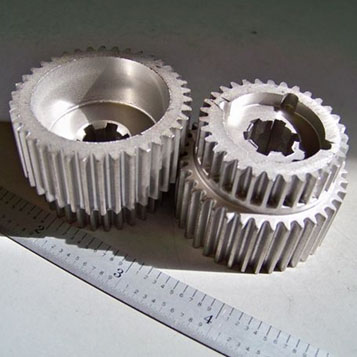
Image: Example of precision engineered gear teeth types.
Process Flow: Manufacturing Precision Gear Teeth Types via Powder Metallurgy
The manufacturing of high-performance gear teeth types, especially for demanding applications like powder metal hammer drill gears, increasingly relies on advanced techniques such as powder metallurgy (PM). This process offers superior material utilization, intricate net-shape capabilities, and excellent control over mechanical properties. Here's a detailed breakdown of the PM process flow:
1. Powder Blending and Material Selection
The journey begins with carefully selected metal powders, often alloy steels or stainless steels, mixed with lubricants and alloying elements (e.g., carbon, nickel, copper). For powder metal hammer drill gears, high-strength alloy steels like FN0205 or FLN4-4005 are commonly chosen for their wear resistance and toughness under impact. Precise blending ensures homogeneous material distribution, critical for consistent mechanical properties in the final gear.
2. Compaction (Pressing)
The blended powder is fed into a rigid die cavity, shaped to the exact negative impression of the desired gear teeth types. High-tonnage presses then compact the powder under significant pressure (typically 30-80 tons per square inch) to form a "green" compact. This green compact has sufficient strength for handling but is still porous. Multi-level tooling allows for complex gear geometries, minimizing the need for secondary machining.
3. Sintering
The green compacts are then transferred to a controlled atmosphere furnace and heated to just below the melting point of the primary metal (e.g., 1120-1150°C for iron-based alloys). During sintering, particles bond metallurgically through atomic diffusion, reducing porosity and significantly increasing strength, hardness, and ductility. The controlled atmosphere (e.g., dissociated ammonia or endothermic gas) prevents oxidation and facilitates carbon control for desired material properties.
4. Secondary Operations (Sizing, Heat Treatment, Finishing)
After sintering, gears often undergo various secondary operations to achieve final specifications:
- Sizing/Coining: Re-pressing the sintered part in a die to improve dimensional accuracy and increase density, particularly beneficial for precise gear teeth types.
- Heat Treatment: Processes like carbonitriding, quenching, and tempering enhance surface hardness and core strength, crucial for wear resistance and fatigue life in components like powder metal hammer drill gears.
- Machining: While PM is a net-shape process, minor machining (e.g., tapping holes, critical datum surfaces) may be performed if extremely tight tolerances are required beyond typical PM capabilities.
- Finishing: Deburring, surface treatments (e.g., steam treatment for corrosion resistance), or specialized coatings further enhance performance and durability.
Testing Standards and Advantages:
All stages are rigorously controlled to meet international standards such as ISO 6892-1 for tensile testing, MPIF Standard 35 for material specifications, and ANSI/AGMA 2000-A88 for gear classification. The service life of PM gears, when properly designed and manufactured, can often exceed that of conventionally machined gears due to optimized microstructure and material properties.
Advantages in Typical Application Scenarios: In petrochemical pumps, PM gears offer superior corrosion resistance through specific alloy choices and coatings. For metallurgical equipment, their high strength-to-weight ratio contributes to energy saving. In water supply & drainage systems, the precision and consistent quality reduce noise and vibration, extending operational uptime. For hammer drills, the precise control of material density and hardness via powder metallurgy ensures extreme durability and impact resistance.
Technical Specifications: Powder Metal Hammer Drill Gears
The following table outlines typical technical specifications for powder metal hammer drill gears, illustrating the precision and performance achievable with advanced powder metallurgy.
| Parameter | Specification Range | Benefit |
|---|---|---|
| Material Grade | FN0205, FLN4-4005, 46F2 | High strength, wear resistance, impact toughness |
| Density | 6.8 - 7.2 g/cm³ | Optimized for strength, ductility, and damping |
| Tensile Strength | 600 - 900 MPa (Heat Treated) | Resists breakage under high stress |
| Hardness (HRC) | 45 - 55 HRC (Case Hardened) | Excellent wear resistance and fatigue life |
| Precision (AGMA Class) | AGMA Q8 - Q10 | Smooth operation, reduced noise, efficient power transmission |
| Surface Finish (Ra) | 0.8 - 1.6 μm | Minimizes friction and wear |
| Geometric Tolerance | Perpendicularity, Concentricity within 0.02 - 0.05 mm | Ensures precise meshing and operational stability |
These parameters are meticulously controlled to ensure that gear teeth types, particularly those for high-stress applications, meet or exceed operational requirements, providing reliable performance and extended operational life.
Key Technical Advantages of Advanced Gear Solutions
Modern manufacturing techniques, particularly powder metallurgy, confer significant technical advantages to gear teeth types, making them indispensable in challenging industrial environments:
- Superior Material Utilization: Powder metallurgy is a near-net-shape process, meaning that the final part is formed very close to its final dimensions. This significantly reduces material waste compared to traditional machining, which can generate substantial swarf. This not only lowers costs but also aligns with sustainable manufacturing practices.
- Enhanced Mechanical Properties: Through precise control over powder composition, density, and heat treatment, PM gears can achieve an optimal balance of hardness, strength, and toughness. This is critical for applications exposed to high shock loads, such as the powder metal hammer drill gears, ensuring prolonged service life and resistance to fatigue.
- Design Flexibility and Complexity: PM allows for the creation of complex geometries and internal features that would be difficult or impossible to produce with conventional methods without significant cost. This flexibility enables engineers to design highly optimized gear teeth types for specific performance requirements.
- Excellent Surface Finish and Dimensional Accuracy: Sizing and coining post-sintering can achieve very tight dimensional tolerances and smooth surface finishes, reducing friction and wear during operation. This translates to quieter operation, higher efficiency, and less frequent maintenance.
- Cost-Effectiveness in Mass Production: While tooling costs can be higher initially, the unit cost for high-volume production of PM gears is often significantly lower than machined or forged alternatives due to reduced material waste, fewer secondary operations, and faster cycle times.
- Noise and Vibration Reduction: The inherent porosity in PM components (even at high densities) can contribute to better damping characteristics compared to fully dense materials, leading to reduced noise and vibration in gear trains, a critical advantage in many industrial and consumer applications.
These advantages collectively contribute to a higher total value proposition for industries seeking reliable, efficient, and durable gear solutions.
Application Scenarios Across Target Industries
The versatility and robustness of modern gear teeth types make them indispensable across a broad spectrum of industries:
- Petrochemical Industry: Gears in pumps, compressors, and agitators require exceptional corrosion resistance and reliability in harsh chemical environments. Helical and spur gears made from specific stainless steel PM alloys excel here, offering extended operational life and reduced downtime.
- Metallurgy and Heavy Manufacturing: Conveyor systems, rolling mills, and heavy-duty presses demand gears capable of transmitting immense torque and withstanding high wear. Worm gears and large spur/helical gears produced via PM or forging provide the necessary strength and durability, contributing to energy saving through efficient power transfer.
- Water Supply & Drainage Systems: Actuators, valves, and pumping stations utilize various gear teeth types for precise control and reliable operation. Gears here benefit from self-lubricating properties (achievable with PM) and corrosion resistance, ensuring long-term functionality with minimal maintenance.
- Automotive Sector: Transmissions, differentials, and engine components heavily rely on precision gears. Helical and planetary gear types with images in mind are critical for smooth operation, fuel efficiency, and compact design. Powder metal gears are increasingly specified for their cost-effectiveness and performance in these high-volume applications.
- Power Tools: Products like hammer drills, circular saws, and grinders require compact, high-strength gears to transmit significant power within limited space. Our powder metal hammer drill gears are specifically designed to endure the extreme impact loads and high RPMs characteristic of these tools, ensuring long life and consistent performance.
- Renewable Energy: Wind turbine gearboxes, solar tracking systems, and hydroelectric turbine governors utilize large, robust gears engineered for long service life and high efficiency under variable loads. Specialized gear designs minimize energy loss and extend operational periods without intervention.
Vendor Comparison: Powder Metallurgy vs. Traditional Manufacturing for Gears
Choosing the right manufacturing process for gear teeth types is a critical decision, impacting cost, performance, and lead time. Here's a comparison between powder metallurgy and traditional methods like forging and CNC machining:
| Feature | Powder Metallurgy (PM) | Forging + Machining | CNC Machining from Bar Stock |
|---|---|---|---|
| Material Utilization | High (97%+) - Near net shape | Moderate (70-85%) - Requires significant machining | Low (50-70%) - High chip waste |
| Design Complexity | Excellent - Intricate geometries, internal features | Good - Limited by forging die design | Good - Limited by tool access and cost for complex features |
| Dimensional Precision | Very Good (AGMA Q8-Q10) - Often net shape | Excellent (AGMA Q10+) - Requires precise machining | Excellent (AGMA Q10+) - Dependent on machine capability |
| Cost (High Volume) | Very Cost-Effective | Moderate to High | High |
| Lead Time (Mass Production) | Short to Moderate (after tooling) | Moderate to Long | Short to Moderate |
| Material Properties | Tailorable, isotropic, good damping | Excellent, anisotropic grain structure | Good, isotropic |
For applications demanding intricate gear teeth types, excellent material utilization, and cost-effectiveness in high-volume production, powder metallurgy often presents the optimal solution. JSSintering leverages decades of expertise in this field, ensuring high-quality and reliable components for demanding industries.
Customized Solutions for Unique Gear Requirements
Recognizing that off-the-shelf solutions rarely meet the precise requirements of all industrial applications, we specialize in providing customized gear teeth types. Our engineering team works closely with clients from conceptualization to final production, ensuring every aspect of the gear — from material composition to tooth geometry and surface treatment — is optimized for the specific operating conditions and performance goals.
Customization options include:
- Material Selection: Tailoring alloy powders (e.g., adding nickel for ductility, molybdenum for strength, or specific elements for corrosion resistance) to withstand unique environmental stresses or operational loads.
- Geometry Optimization: Designing specific pressure angles, helix angles, tooth profiles, and modules for ideal mesh efficiency, noise reduction, and load distribution for various gear teeth types.
- Heat Treatment Protocols: Implementing custom carbonitriding, carburizing, or induction hardening cycles to achieve desired core hardness, case depth, and surface hardness for optimal wear and fatigue resistance.
- Surface Coatings and Treatments: Applying steam treatment for enhanced corrosion resistance, or specialized coatings (e.g., DLC, PVD) to reduce friction and improve wear characteristics in extreme conditions.
- Integrated Features: Incorporating additional features such as splines, keyways, or complex hubs directly into the gear design through the PM process, eliminating costly secondary assembly steps.
Our certified facilities adhere to stringent quality management systems, including ISO 9001 and IATF 16949, ensuring that all customized gears different types meet the highest standards of quality and reliability, backed by comprehensive testing and validation processes.
Application Case Studies: Real-World Performance
Case Study 1: Enhanced Durability in Industrial Robotic Arms
A leading manufacturer of industrial robotic arms sought to improve the service life and precision of their gearboxes, which utilize planetary gear teeth types. Traditional machined gears were experiencing premature wear under continuous heavy load cycles. By transitioning to custom-designed powder metal gears made from a high-strength, heat-treated alloy, we achieved a 40% increase in fatigue life and a 25% reduction in operational noise. The net-shape capabilities of PM also allowed for the integration of complex hub features, reducing assembly time by 15% and overall component cost by 10%.
Case Study 2: Performance Boost for High-Impact Power Tools
A prominent power tool company approached us to develop more robust powder metal hammer drill gears. The existing components were prone to chipping and accelerated wear due to the intense impact and rotational forces during drilling. We engineered a specific ferrous alloy powder with optimal nickel content and implemented a tailored carbonitriding heat treatment process. The resulting gears demonstrated a 50% improvement in impact resistance and a doubled service life in accelerated durability tests, leading to significant warranty claim reductions and enhanced brand reputation for the client.
Case Study 3: Corrosion Resistance in Marine Applications
A manufacturer of marine propulsion systems required highly corrosion-resistant gears for submerged applications. Traditional stainless steel gears were costly to machine and often failed prematurely due to crevice corrosion. We developed specialized gear teeth types using a high-chromium powder metal alloy with a steam treatment post-sintering. This solution provided superior corrosion resistance, comparable to more expensive wrought alloys, while reducing manufacturing costs by 30% and significantly extending the operational lifespan in saltwater environments.
Frequently Asked Questions (FAQ)
- Q: What are the primary advantages of powder metal gear teeth types over machined gears?
- A: Powder metal gears offer significant advantages in terms of cost-effectiveness for high-volume production, superior material utilization (near-net-shape), and the ability to produce complex geometries that are difficult or impossible to machine. They also allow for tailored material properties and excellent surface finish.
- Q: Can powder metal gears withstand high-impact loads, such as in hammer drills?
- A: Absolutely. With appropriate alloy selection, compaction density, and secondary heat treatments (e.g., carbonitriding), powder metal hammer drill gears are specifically engineered to provide exceptional impact resistance and durability in high-stress applications.
- Q: What kind of quality control measures are in place for your gears?
- A: Our manufacturing processes adhere to stringent international standards such as ISO 9001 and IATF 16949. We employ comprehensive in-process testing, including dimensional checks, density measurements, hardness testing, and metallurgical analysis, ensuring every batch of gear teeth types meets precise specifications.
- Q: What is the typical lead time for custom gear orders?
- A: Lead times vary based on design complexity, material selection, and production volume. For new custom tooling, it typically ranges from 8-12 weeks for samples. Once tooling is established, production orders for standard gear teeth types usually ship within 4-6 weeks. We work closely with clients to meet specific project timelines.
Lead Time, Warranty, and Customer Support
Lead Time & Fulfillment
Our efficient manufacturing processes and robust supply chain management enable us to offer competitive lead times. Prototype and tooling development typically takes 8-12 weeks, depending on complexity. Subsequent production runs for standard gear teeth types are generally fulfilled within 4-6 weeks. We offer flexible shipping options globally to meet our clients' logistical needs, prioritizing on-time delivery.
Warranty Commitments
We stand behind the quality and performance of our gear teeth types. All products are manufactured to stringent specifications and come with a standard warranty against manufacturing defects. Specific warranty terms and conditions are outlined in our sales agreements, reflecting our commitment to client satisfaction and product reliability.
Dedicated Customer Support
Our commitment extends beyond delivery. We provide comprehensive after-sales support, including technical assistance, troubleshooting, and replacement parts. Our team of experienced engineers and customer service professionals is readily available to address any inquiries or support requirements, ensuring seamless integration and optimal long-term performance of our gears different types in your applications. Contact us via phone, email, or our online portal for prompt assistance.
References
- MPIF Standard 35, Materials Standards for Powder Metallurgy (PM) Parts, Metal Powder Industries Federation.
- ISO 9001:2015 - Quality management systems — Requirements. International Organization for Standardization.
- AGMA 900-H06 - Fundamental Rating Factors and Calculation Methods for Involute Spur and Helical Gear Teeth. American Gear Manufacturers Association.
- German, R.M. (2014). Powder Metallurgy and Particulate Materials Processing. Metal Powder Industries Federation.
- ASM Handbook, Vol. 7: Powder Metallurgy (1998). ASM International.









