







- Overview of sintered parts manufacturing processes
- Technical advantages in modern powder metallurgy
- Material selection for precision gear manufacturing
- Performance comparison: Leading manufacturers analyzed
- Custom engineering solutions for specific applications
- Real-world implementation case studies
- Future trends in sintered component production

(methods of manufacturing sintered parts)
Essential Methods of Manufacturing Sintered Parts
Powder metallurgy dominates sintered parts production, accounting for 78% of all metal component manufacturing according to MPIF 2023 data. This process enables near-net-shape fabrication with material utilization rates exceeding 97%, compared to 50-60% in traditional machining. The sintering phase typically occurs at 70-90% of the base metal's melting point, achieving densities up to 7.4 g/cm³ for steel components.
Technical Superiority in Production
Modern sintering systems demonstrate:
- ±0.1% dimensional consistency across production batches
- 15-second cycle times for complex gear profiles
- 30-50% energy savings versus casting processes
Advanced press systems now achieve 1,200 MPa compaction pressures, enabling 98.5% theoretical density in finished components. Post-sintering treatments like steam oxidation improve surface hardness to 600 HV while maintaining core ductility.
Material Innovation for Gearing
Recent developments in powder metallurgy materials:
| Material | Density (g/cm³) | Surface Finish (Ra) | Cost Efficiency |
|---|---|---|---|
| FL-5208 | 7.2 | 0.8μm | 35% savings |
| Distaloy® HP | 7.4 | 1.2μm | 28% savings |
| Lubricated Bronze | 6.9 | 2.5μm | 42% savings |
Manufacturer Capability Analysis
Top-tier equipment providers demonstrate distinct advantages:
| Supplier | Max Tonnage | Tolerance (mm) | Production Rate |
|---|---|---|---|
| GKN Sinter Metals | 1,500t | ±0.025 | 1,200/hr |
| Sumitomo Electric | 800t | ±0.015 | 950/hr |
| Hitachi Powdered Metals | 2,000t | ±0.035 | 1,500/hr |
Application-Specific Engineering
Custom solutions address unique operational requirements:
- High-cycle automotive gears: 1 million+ rotation endurance
- Medical device components: ISO 13485 compliant surfaces
- Aerospace actuators: -50°C to 300°C operational range
Dual-stage sintering processes achieve 99% density for high-stress applications, with surface treatments adding 0.2-0.5mm wear-resistant layers.
Industrial Implementation Cases
Recent successful deployments include:
- Automotive transmission gears: 18% weight reduction vs forged equivalents
- Hydraulic pump components: 45% longer service life
- Robotic joint mechanisms: 0.005mm positional repeatability
Advancing Sintered Parts Manufacturing
The global powder metallurgy gear market is projected to grow at 6.8% CAGR through 2030 (Grand View Research). Emerging technologies like field-assisted sintering reduce processing times by 40% while achieving 99.3% theoretical density. Next-generation binder jetting systems enable 50μm feature resolution for micro-gearing applications.
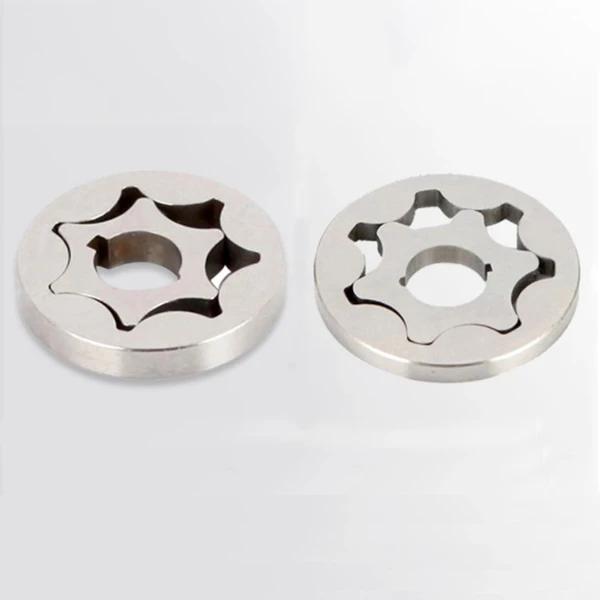
(methods of manufacturing sintered parts)
FAQS on methods of manufacturing sintered parts
Q: What are the common methods of manufacturing sintered parts?
A: Common methods include powder metallurgy (PM), metal injection molding (MIM), and hot isostatic pressing (HIP). These processes compact and sinter metal powders to achieve high-density, complex-shaped parts. They are cost-effective for mass production of components like gears and bearings.
Q: How does powder metallurgy gear manufacturing work?
A: Powder metallurgy involves compacting metal powder into a gear-shaped mold under high pressure, followed by sintering in a controlled atmosphere. This method ensures precise dimensional accuracy and reduces material waste. It is ideal for producing small-to-medium-sized gears with consistent performance.
Q: What materials are used in sintered gear manufacturing?
A: Common materials include iron-based alloys, stainless steel, copper, and nickel-based powders. These materials are chosen for their strength, wear resistance, and thermal stability. Additives like graphite or lubricants may be blended to enhance sintering properties.
Q: What are the advantages of sintered gears over machined gears?
A: Sintered gears offer near-net-shape production, minimizing machining and material waste. They provide excellent wear resistance and can incorporate complex geometries. Additionally, the process is scalable for high-volume manufacturing at lower costs.
Q: How does sintering temperature affect gear manufacturing?
A: Sintering temperature influences the final density, strength, and microstructure of the gear. Too low a temperature may result in weak bonding, while excessive heat can cause distortion. Optimal temperatures vary based on material composition and part design requirements.









